Friday, 25 September 2020

Caronia, No. 17 Bowen Road - the history of a house

A friend of mine recently moved into a charming colonial house named 'Caronia' at No. 17 Bowen Road. Although I have often walked or jogged along Bowen Road I never knew this house existed. It is hidden in the trees and the only access is by steps leading up from Bowen Road. Bowen Road runs for 4 km from Magazine Gap Road to the junction of Stubbs Road and Tai Hang Road. No. 17 is the last house on the vehicular stretch of Bowen Road after which access is available for pedestrians only. The road is named after Sir George Bowen, Governor of Hong Kong from 1883 to 1885. The aqueduct section consisting of 21 granite arches was built between 1885 and 1887. The house may have been  named after the Cunard liner RMS Caronia launched in 1904 on Clydeside.  Perhaps the house owner had a romantic relationship on the ship. The house equally well could have been named after the charming Sicilian hill-top town bearing the same name. The house was built in 1923. The three neighbouring houses at No. 16, No. 15 and No. 14 were completed around the same time.  An old house like this must have an interesting history. My friend asked me if I could look into the history of the house and find out something about the people who lived there. These four colonial houses were clearly visible from anywhere in Hong Kong or Kowloon. The photograph below shows them in 1949.


No. 17, 16, 15, and 14 Bowen Road (Source: Getty Images - Common Usage)

Today, No.16 has been demolished and a new building is being constructed. No.15 has been subject to substantive renovation and structural work which has altered its original appearance. No. 14 has been completely demolished and two modern houses have been built on a concrete podium  above the road on the original plot. Only Caronia remains pretty much unchanged.


Map showing the four properties

Formerly No. 14 (now 12b and c) 

No. 15 Bowenn Road

The garage block - perhaps originally one for each house

What is left of No. 16

My first view of the house, No. 17,  through the trees 

Set amongst trees and splendid gardens

The Terrace

View from the roof

History enthusiast, Alex Macdonald, did a search at the land registry and found that No 17 was completed in 1923. The first registered owner was Captain Frank Leader Brown born 5 October 1888 and passed away 8 August 1968 in Worthing, Sussex.  He served in the Royal Engineers since 1907/1908 when he is listed as a subaltern. When WW1 broke out in 1914 he had attained the rank of Captain. Records indicate that he served in Hong Kong before the war as he gives an address in 1913 as Royal Engineers Mess Wellington Barracks, Hong Kong. Forces war records indicate that he saw service in Italy during the war. Locations included Monte Cassino, Anzio, Salerno and San Marino. Could this be the reason he named the house Caronia. 

After the war, possibly in 1922, he left the Army and came back to Hong Kong. He appears on Juror's Lists in 1923, when the house was completed and is listed as a Civil Engineer working for Hongkong Electric (HKE). His address is given as No. 17 Bowen Road. This continues from 1923 until 1941 indicating that he lived at No. 17 for those eighteen years until the war started in December 1941.

In June 1928, he is listed on the manifest of Empress of Australia returning to the  UK with his widowed mother Mary Gertrude Brown of Littlecourt, Goring-upon-Thames. He was thirty-nine and his mother was sixty-two. They travelled from Hong Kong via Manila and Vancouver and then across the continent to board the Empress of Australia at Quebec. Travelling with them was Muriel Winifred Holmes (nee Bateman) the wife of Harold Kennard Holmes, whose address, strangely enough,  is given as No. 17 Bowen Road. Did they all live together or did Harold Holmes house-sit for them? Harold and Muriel Holmes had married in 1905 at St John's Cathedral. She had previously been a teacher at Belilos School.

Had Harold and Muriel's marriage broken down? Was there a romantic relationship between Muriel Holmes and Frank Brown? There certainly was later, as Frank and Muriel married. I have not found a date for the marriage but it was probably in the early or mid-1930s. Harold Holmes later married Ellen Florence in 1938 in Essex. The marriage did not last long because he died four years later in 1942. 

They were interned at Stanley Camp in January 1942. They were billeted in A4/15 which was in the Prison Officers Club Building. They retired to Worthing where Muriel died in 1967 and where Frank died the following year.

The next owner of No. 17 came as a bit of a surprise. I recognised the name immediately. It was Elizabeth ('Emma') Appleton Fidoe. She was one of the five European volunteer military nurses who were raped by Japanese troops at St Stephen's College Hospital on 25 December 1941. She is listed as an owner of No. 17 from 1948 until 1951 when the London Missionary Society acquired the house possibly under the terms of her will. 

Emma Fidoe (nee Dudley) was of Irish extraction born in Kilkenny in 1898. Her family moved to Aldershot, England. Her father was working with the British Army (possibly in a civilian role). She became a nurse, and at one stage was working as Matron at the London Jewish Hospital. She married SQMS (Staff Quarter Master Sergeant) Joseph Henry Fidoe, RAOC in December 1935. The marriage is referenced in the China Mail 31 December 1935. The wedding took place at St John's Cathedral. The newspaper reports that Emma had just arrived in Hong Kong on the troopship HMT Neuralia. The ship was sunk by a mine in 1945.

HMT Neuralia (Source: the-weatherings.co.uk)

Joseph Fidoe was born in 1891. He had served abroad since 1931 in Egypt, China and Hong Kong. He had been married twice before. His first wife, Nelly Proudman, had predeceased him. They married in 1912 and had a daughter Molly. Nelly died in 1925 and in the same year, Joseph Fidoe married May Dudley in London. She was Emma's sister. She died in China in 1934. The following year he married his thirty-seven-year-old sister-in-law, Emma. The wedding was a big event with a well-attended reception at the Gloucester Hotel. A few years later, Joseph Fidoe left the Army and in 1938 appears on the Jurors List as an employee of Tai Koo Dockyard. However, after this, he seems to disappear into the ether.  He was not in Hong Kong in December 1941. So what happened to him - did he predecease Emma? Did they separate and divorce? I can not find any record of his death. We know that Emma was working as a military nurse serving with the Nursing Detachment of the HKVDC in December 1941 and that she was raped and abused by Japanese soldiers on Christmas Day after they took over St Stephen's Collge Hospital. We know that she was not interned at Stanley Civilian Internment Camp. She must have avoided internment on the grounds of Irish (neutral) nationality. How did she survive in Japanese occupied Hong Kong? What was the source of her funds? Did she continue to practice as a private nurse? All we know is that in October 1945 she was repatriated on the hospital ship HMHS Oxfordshire.  She was demobbed from the Nursing Detachment in London in May 1946 and then returned to Hong Kong to resume her career as a private nurse. 

In 1948, she appears as the new owner of No. 17 presumably assigned to her by Frank Leader Brown but how does a nurse afford a house like this and why did she need such a large house. Emma lived at Caronia until her premature death aged 52 in 1951 at Queen Mary Hospital following an illness.


Letter from Emma to Adjutant ND, HKVDC dated October 1946 (Source: HK PRO)


Letter from Commandant of ND HKVDC to Emma (Sept. 1945) (Source: HK PRO)


Notice of probate (Source: Ancestry.com)

The next owner of Caronia, No. 17 Bowen Road,  was the London Missionary Society (LMS) - it may have been bequeathed to the society by Emma Fidoe. The LMS retained it only until 1954. The next owner was Elsie Sue Ming. Joseph Luk and Moira Moser who lived at Caronia as long-term tenants advised me that she (Elsie) had set up a school at Caronia called Marymount. After Elsie Sue Ming's death the property was acquired by the Fung Family who have owned it since 1978.

Houses have a history, they have tales to tell about the people that lived in them, the lives they led, the things that they witnessed, their happiness and sadness. It's wonderful that this house still remains to whisper evocatively of days gone by and how things used to be.  To quote the writer, L. P. Hartley, "the past is a foreign country they do things differently there."

...............


The Neighbours - No. 16, 15 & 14

No. 16 is now demolished. A new structure will go up in its place no doubt lacking any sort of charm that these old houses once exuded. We have not yet been able to find the previous registered owners. I did notice that in 2012 it was sold by Tony Chan, the feng shui master, closely linked to Nina Wang, for the princely sum of HKD380mm.

No. 15 is still the original house although  after much structural renovation. The house was constructed in 1920. The first owner is listed as Thomas William Shearstone. He may have been the developer. The house was acquired in 1923 by brothers William and Anthony Carroll along with No 14. In 1925, the property was acquired by Peak Tramways who owned the property until after the war. 

No. 14 has been demolished and the two new properties built on the plot  have been re-numbered  12 (b) and 12 (c). The less than charming building incorporates the Seychelles Consulate. As with No 15  it was first owned by TW Shearstone (possibly the developer). The house was assigned to the Carroll Brothers in 1923. It was assigned to HK Telephone Co in 1947. In December 1941. Henry and Sarah Refo and their four children were renting No 14 from the Carrol Brothers. The Carroll brothers were considered as traitors by the British and had been interned together with Japanese and Italian civilians. 


Acknowledgements:

Ted Lee

Alexander Macdonald 

Joseph Luk 

Moira Moser


Wednesday, 16 September 2020

23 Coombe Road - the story of a house

The house was known during the Battle for Hong Kong as Glen Iris or simply as No. 530 the Peak. It still remains and is one of the oldest surviving residential houses in Hong Kong. It is known today as No. 23 Coombe Road and sometimes referred to as Carrick. It is currently empty and looks weathered, dilapidated and uncared for, but it has an interesting history. In recent years it has been subject to some controversy. The Hong Kong Government agreed to a land swap with the current owners so that the government could preserve this historic building. The owners who had applied to redevelop the property were given in exchange a plot of land across the road on which they could build a large residential house. The controversy relates to objections mainly from residents of Coombe Road who think that the new property will mar the countryside and disturb the ecology. Some of the detractors of the scheme feel that No. 23 is unattractive, not particularly notable, and should be redeveloped rather than preserved through the land swap arrangement.

Coombe Road links Magazine Gap with Wan Chai Gap. House No. 23 is situated near where Coombe Road joins with Wan Chai Gap, and close to the former Police Station which now houses the Police Museum. The plot for No. 23 was acquired by John Joseph Francis, an Irish soldier who first came to Hong Kong in 1859 and later became a prominent lawyer and long term resident of Hong Kong.  J.J. Francis acquired the land in 1886 and built the house in 1887. He named it Stonyhurst.  The house was built in the Palladian style and designed by architects Danby & Leigh, the forerunner to the firm of Leigh and Orange.

The entrance to No 23 today (Writer's Collection)

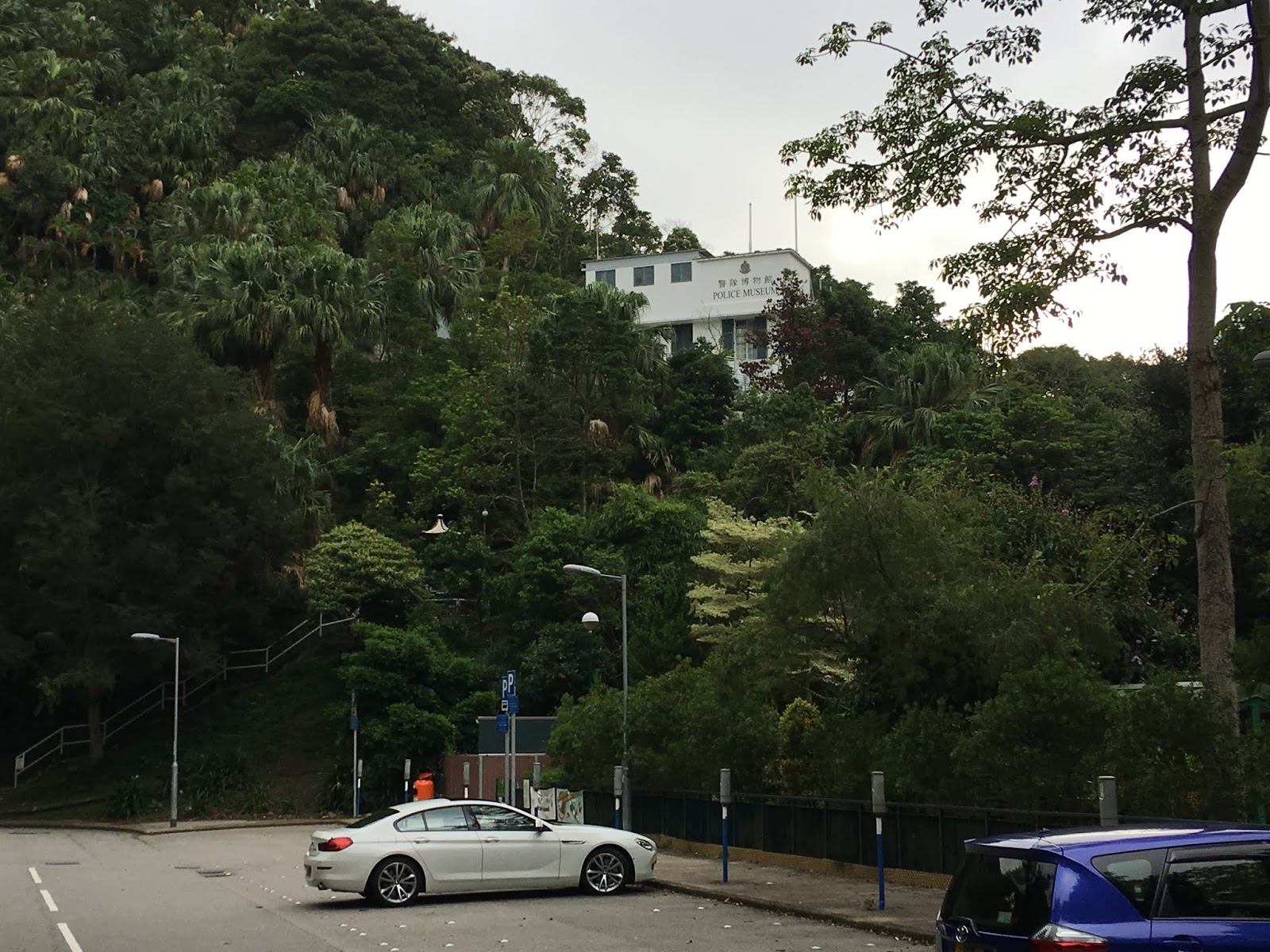
The former police station -  now a museum
The first owner J.J. Francis was born in Dublin in 1839. He joined the Royal Artillery and served in Hong Kong in 1859. He discharged himself from the Army by purchase and continued to live in Hong Kong. He became a solicitor's clerk and later qualified as a solicitor. After Francis died in 1901 the property changed hands several times until in 1921 it was acquired by Hong Kong Electric Co. who owned it until 1976. At this time the house was known as Glen Iris or No. 530, The Peak. This is how it is shown in the 1938 road map of the Peak below. 


Road Map of Peak District dated 1938 (Govt. Maps Office)
The area encompassing Coombe Road, Magazine Gap, Wan Chai Gap, Middle Gap Road and Mount Cameron Road was a major military zone during the Battle of Hong Kong. The area was heavily bombed, shelled and fought over. The Winnipeg Grenadiers Battalion HQ was located at Wan Chai Gap. West Infantry Brigade and West Group Royal Artillery had their HQ's located here after West Brigade Shelters were destroyed on 19th December 1941. The Royal Scots also had their Bn HQ at Wan Chai Gap during the latter part of the battle. Most of the private houses along the three roads (Middle Gap Rd, Mount Cameron Rd and Coombe Rd) were occupied by the military. Some of the wartime military structures still survive like the re-purposed splinter proof shelters on Mount Cameron Road. 

Major Kenneth Baird, Winnipeg Grenadiers, in Letters to Harvelyn (1957) recalls that No. 530 The Peak was used as an officers mess by the Canadian Army. 
"After making my report and asking for orders, [from Lt-Col Sutcliffe at Bn HQ] he sent me up to the mess at 530 Coombe Road, just near our battalion HQ. This house was someone's beautiful home." 
"Our mess at 530 Coombe Road was selected because it was close to the central dugouts where every part of our defence system on the Island was linked by phone. I had my company office in a huge house - 528, Coombe Road. The second day there, the Japs put a 6-inch shell in one of the rooms killing six men and wounding several more."  
According to the 1941 Jurors List, No. 530  was the home of Edgar Thompson, a senior engineer with Hong Kong Electric Co Ltd. Thompson was also a member of the special guard contingent of the HKVDC known as the Hughes Group. He was captured whilst defending the HKE power station at North Point on 19th December 1941. He was incarcerated in POW Camp for the duration of the war. His wife Maisie and daughter Ann had been evacuated before the war. Edgar Thompson survived the period of incarceration and returned to Hong Kong after the war as Chief Engineer of HKE. The family were later to re-occupy their pre-war home at No. 530 The Peak. Thompson retired in 1954.

No 528, The Peak where Major Baird had his Coy HQ was the house immediately next door to No. 530. Captain Terry, Paymaster was wounded and hospitalised, and Major Baird was slightly injured at No. 530 (the mess). This occurred when Captain Terry was shaving in a bathroom on the second floor, and Major Baird was standing in the doorway chatting with him when a shell hit the wall above the bathroom window. The bathroom was wrecked. Terry was badly injured and Baird was thrown fifteen feet into the next room. At the time there were around ten officers having breakfast in the dining room on the ground floor. They had felt the impact as the shell hit the upper floor, but the house was strongly built and sustained little external damage.

In happier times (Source: Chinarhyming.com)
Today - with an air of faded gentility, dilapidation and decay (Writer's Collection)

In 1986, Walter Greenwood, a Hong Kong lawyer and Magistrate, published a detailed and well-researched article about John Joseph Francis, in the Journal of the Royal Asiatic Society, Hong Kong Branch. (Volume 26). He, JJ Francis, had done much for the local Chinese community, for example, he had actively campaigned to stop the mui tsai system in which Chinese girls were subject to a form of slavery. He had also contributed to the efforts to fight the spread of the bubonic plague. He was instrumental in forming the Po Leung Kok, a society for the protection of the innocent. 

Hidden among the trees, but with a story to tell (Source: Writer's Collection)

This is a house with an interesting history dating back to 1887. It is good to see that the house has been protected from demolition and redevelopment. Now the authorities need to ensure that it is well conserved and put to good use. Perhaps a museum focused on the history of the Peak, with exhibits, coffee shops and dining so that the sound of people conversing and children playing can reverberate once more through its empty rooms and passageways. It's a place that deserves to be cherished as part of Hong Kong's history and brought to life again.

Addendum (1) dated February 2026

I was recently contacted by Tim Sorby, the grandson of Vincent Dare Sorby, the General Manager of HK Electric Co. (HKE) who in December 1941 was fatally wounded in the Battle for the HKE Power Station at North Point while seving with the HKVDC. Vincent Sorby had lived at 23 Coombe Road (530 The Peak) while he was Chief Engineer of HKE. When he became General Manager just before the war he moved to 253 The Peak. No. 530 being reserved for the Chief Engineer and No. 253 being reserved for the General Manager. Vincent Sorby died in January 1942 in POW camp from the wounds he incured and was buried first at Argyle Street Camp burial ground and later reburried at Sai Wan Military Cemetry. 

Tim sent me a number of historic photos of the house which are included in the gallery below. 

Photo Gallery

      530, The Peak circa 1926 from an album compiled by Terence Sorby (Courtesy Tim Sorby)

     530, The Peak taken circa 1929 from an album compiled by Terence Sorby (courtesy of Tim Sorby)


530, The Peak taken circa 1929 from an album compiled by Terence Sorby (courtesy of Tim Sorby)

                                The fireplace as it was at 530, The Peak (courtesy of Tim Sorby)


            The fireplace as it is today (HK Gov't web site 'Conserve and revitalise Hong Kong')


Addendum (2) - Mr Vincent Dare Sorby and Mrs Patricia Sorby

Vincent Sorby lived in the house at Coombe Road before the war while he was Chief Engineer at HK Electric. HK Electric bought the house 1n 1921 and owned it until 1973. When Sorby became General Manager he moved to a new location at 253 the Peak.  Sorby was born in 1881 and joined HK Electric in 1901. He saw war service in the South African (Boer) War. Then in WW1 he served as a gunner on Empress of Russia an armed merchant cruiser. In WW2 he served with the Hughes Group of the HKVDC. He was wounded in December 1941 whilst defending the HK Electric power station at North Point. He died from his wounds in POW Camp. 

He married Josephine Patricia Conway (known as Pat)  in 1917. She had come to Hong Kong as a teacher. During the Japanese occupation she was not interned as she was born in Ireland and could therefore claim neutral nationality. She was not supplied with Japanese ration cards and living without an income in occupied Hong Kong would have been difficult and frought with danger.  She somehow got herself to Macao, the neutral Portuguese enclave. After the war she moved to England in April/May 1946. She died in 1951 aged 61.


                                                                   ...........................

Battle of Waterloo - Ensign Thomas Deacon wounded at Quatre Bras and a daughter born during the Battle of Waterloo

The Battle of Waterloo was fought on Sunday, 18 June 1815. It was a contest between the coalition of Britain, Prussia, the United Kingdom of the Netherlands including Belgium, and the Germanic States of Hanover, Nassau and Brunswick; and against the re-assembled French Army under the command of Emperor Napoleon Bonaparte. Bonaparte had escaped from exile on the Mediterranean island of Elba in February 1815. He landed at Antibes in the South of France with his personal escort of 600 men and marched towards Paris. Louis XVIII, the newly restored King of France sent an army to stop him, but the army allied themselves with the old Emperor and joined his ranks. The King, a constitutional monarch, who had spent so much of his life in exile, fled Paris and Bonaparte marched into Paris, unopposed, at the head of a large and still growing army.
   The coalition included Russia and Austria, but they were not able to raise their respective armies in time for military intervention. The coalition formed two armies, a British Army and their Dutch and Germanic allies, under the command of the Duke of Wellington, and a Prussian Army under Field Marshal Von Blucher. The British Army included the King's German Legion mainly comprised of Hanoverians who had fled to Britain to serve in the military with the aim of freeing their homeland from Napoleonic occupation. In June 1815, Bonaparte left Paris at the head of an army of some 123,000 men and 360 guns with the intent of defeating the two opposing armies before they could come together. The defeat of the two armies would open the way for the subjugation of continental Europe.
   Lord George Byron, the romantic poet and adventurist, described the allied countries, in his lengthy epic poem Childe Harold's Pilgrimage, as the 'United Nations', and in so doing, gave rise to the moniker that replaced the League of Nations. It was a massive set-piece battle that from the outset stirred the imagination of Georgian Britain and the rest of Europe. It was a clash between the nation-states of Europe and the concept of the French-controlled superstate. The victory brought peace to Europe for some 100 years.
    Charlotte, the Duchess of Richmond, hosted a ball in Brussels on the night of 15 June. It was attended by the Duke of Wellington with his officers, many of whom were accompanied by their ladies, who had come out to Brussels to be with their husbands. It was by all accounts a grand occasion.

The Duchess of Richmond's Ball by R.A. Hillingford
Byron captured the essence of the evening so vividly in his poem The Eve of Waterloo. He describes how the ball was interrupted by the cacophony of the cannon's opening roar. It was a call to arms, the army of Napoleon Bonaparte was heading to Brussels.
There was a sound of revelry by night, And Belgium's capital had gathered then Her beauty and her chivalry, and bright The lamps shone o'er fair women and brave men; A thousand hearts beat happily, and when Music arose with its voluptuous swell, Soft eyes looked love to eyes which spake again, And all went merry as a marriage-bell; But hush! hark! a deep sound strikes like a rising knell!  
The opening battle was fought at Quatre Bras on 16th June, and the main battle two days later at a location on rising ground south of the village of Waterloo. The battlefield is still a very popular tourist destination, just as it was in the 19th century. The topography has been somewhat altered by the amount of soil dug up for the construction of the Butte du Lion (the Lion Mound) seen in the photograph below. The construction of the mound was commissioned by King William of the Netherlands in 1820 and was completed in 1826 near the spot where his son, the Prince of Orange, was wounded in the battle.

The Writer on the Battlefield of Waterloo with Butte du Lion in the background

You can ascend to the base of the lion by a steep flight of steps. The platform below the lion provides in one coup d'oeil a 360-degree view of the battlefield, the sunken lane, and the farmhouses of La Haye Sainte and Hougoumont. The mound commemorates all those who fought, and the many who died, at Waterloo and Quatre Bras. There is also a circular building near the mound that is called the panorama. It houses a painting 360 foot long and 39 foot high that was commissioned in 1912. 

    I am digressing, so let me now return to the subject of this post. He was a young officer, an Ensign, by the name of Thomas Deacon who fought at Quatre Bras and was wounded in the battle. His pregnant wife with two young children walked from Quatre Bras to Brussels searching for her wounded husband. She found him in a military hospital in Brussels. She by then was exhausted, famished, sick and wet-through. Her baby was delivered that night on 18 June and named Waterloo Deacon.

    I first heard of Thomas Deacon when reading a book with the rather grand title Recollections of Military Service, in 1813, 1814, and 1815 through Germany, Holland, and France including some details of the Battles of Quatre Bras and Waterloo. The book was written by Sgt Thomas Morris who served with the 73rd Regiment of Foot. It was first published in 1845 and is one of several first-hand accounts of the battle. 


    Whilst advancing under fire through the rye fields at Quatre Bras, Sgt Morris recalled that Ensign Deacon was on his right-hand side. On his left was Private Sam Shortly. Pte Shortly was killed outright by a musket ball to the forehead. Ensign Deacon was severely wounded by a musket ball that passed through his arm. The young officer withdrew to the rear to get his wounded arm dressed and attended. Deacon had been accompanied by his wife Martha and their two children who were somewhere in the rear. After having his wound dressed he looked for his wife but was unable to find her, and was later put on baggage-train to Brussels for hospitalisation. Martha heard from soldiers from her husband's battalion that her husband had been wounded and conveyed to Brussels.

28th Regiment of Foot form a square to fend off French cavalry at Quatre Bras (by Lady Butler)
Martha and her two young children, Louisa Maria (b. 1809) and Charles Clemments (b. 1811) walked all the way to Brussels, a journey of some twenty miles.
Conveyances there were none to be had, and she was in in the last stage of pregnancy, but encouraged by the hope of finding her husband, she made the best of her way on foot, with her children, exposed to the violence of the terrific storm of thunder, lightning, and rain, which continued without intermission for about ten hours. Faint, exhausted and wet to the skin, having no other clothes than a black silk dress and light shawl, she yet happily surmounted these difficulties, reached Brussels on the morning of 18th, and found her husband in very comfortable quarters, where she was also accommodated; the next day giving birth to a fine girl, which was afterwards christened Waterloo Deacon. (Sgt Thomas Morris)
Thomas Deacon was born in 1788. He married Martha Ann Durrand on 31 August 1809. They married at St George's Church in Hanover Square. They were both aged twenty-one. She was the daughter of John Hodson Durand, who was Member of Parliament for Maidstone from 1802 to 1806. She appears to have been from a well-to-do family. However, I can not find much information on Thomas Deacon. I wonder whether he may have been a soldier in the rank and file. This is pure speculation but if he was an NCO, rather than a commissioned officer their marriage may not have been approved by her family and she may not have received financial support. Their first daughter Louisa was born in Woolwich, an Army depot, in 1809, in the same year in which they married. Suggesting the marriage may have been a necessity.  Their son Charles Clements was born in Hythe in 1811, another Army garrison town. This suggests that Thomas Deacon may have been in the Army before he was commissioned in the 73rd Regiment in April 1813 at the rather late age of twenty-five.  It would not be late if he had been commissioned from the ranks. We know his commission was not purchased. At that time officers in the cavalry and infantry regiments generally purchased commissions. There were exceptions, for example, the Royal Artillery and the Royal Engineers commissioned those who had attended training courses at their depots, and promoted on merit and seniority. During the Napoleonic Wars, there was a shortage of officers which was not filled by those willing to purchase a commission in the normal way. Gentlemen generally purchased commissions, and there was a derogatory term of 'not quite gentlemen' for some officers commissioned other than by purchase, for example by merit on the battlefield. There were some officers who were gentlemen, but impecunious, and could not afford to purchase a commission. Some of these joined as rank and file but messed with the officers. They looked to distinguish themselves during the battle to win a commission.  Perhaps Deacon was one of these.
   Gordon Corrigan in Waterloo A New History of the Battle and its Armies  (2014) sets out the cost of purchasing a commission as an Ensign as being £900 for the prestigious Foot Guards and £400 in the Line infantry. The purchase price would be nine and four times the annual salary of an ensign. A sergeant could be commissioned without purchase following gallantry on the battlefield or a record of long service and good conduct. Gordon Corrigan suggests that as many as 10 per cent of officers at Waterloo had been commissioned from the ranks. Officers commissioned from the ranks were particularly useful as Adjutants as they were responsible for drilling, which was vital in battle in getting men into position and to form squares etc. Deacon served as an Adjutant in Ceylon.
    Waterloo Deacon, born 18 June 1815 during the Battle of Waterloo, was in fact christened Isabella Fleura Waterloo Deacon. After recovering from his wound, Thomas Deacon was promoted to the rank of Lieutenant and was sent out to India and Ceylon. During Deacon's service in the Far East, Martha had five more children, but four of these died in infancy. Thomas Deacon reached the rank of Brevet Major in 1846. He died in 1853, whilst still serving in the Army, at the late age of sixty-five. He was buried in Madras, Southern India. Martha his loyal, long-suffering wife, died in 1855.
    As for Isabella Fleura Waterloo Deacon, as far as I can see she never married. She lived a long life and died in 1900 in Southsea, Hampshire. The local newspaper The Hampshire Advertiser reports the death of Isabella Fleura W. Deacon. I wonder whether she had stopped using Waterloo in her name. At the time of her death, she had been living with her niece who was the daughter of her brother, Charles Clements Deacon, who had walked, with his mother and sister from Quatre Bras to Brussels where Isabella was born in a military hospital just as the Battle of Waterloo unfolded and changed the history of Europe.


...............................................


Main Sources:

Recollections of military service in 1813, 1814, and 1815  by Thomas Morris

Ancesty.com

A blog entitled All things Georgian www.georgianera.wordpress.com


Monday, 10 August 2020

ZBW Radio broadcasting under fire - December 1941

ZBW Radio broadcasting under fire in the Battle for Hong Kong

In 1941, the radio set, or wireless,  occupied a central position in every home. It was still a  relatively new phenomenon. Radio broadcasting in Hong Kong started in 1928. The local radio station was known as ZBW. The name changed to Radio Hong Kong in 1948. ZBW would re-broadcast programmes from the BBC Empire Service. The BBC news would start with the announcement 'Daventry Calling'. The transmitters were located on Borough Hill near the Northamptonshire village of Daventry. The radio made Daventry famous. The radio programme was published in the daily newspapers. The ZBW service started broadcasting at 12:15 p.m. with a 'short service of intercession' which infers some sort of morning prayers. The programme would include sessions for Chinese, Portuguese and Indians. Dance music was always popular and of course the news bulletins. There would be a break in the afternoon, and when programming closed in the evening the national anthem would be played. 

Source:  © Eric Shackle Collection, Radio Heritage Foundation

My thanks to Eric Shackle and Radio Heritage Foundation for allowing me to use the above ZBW photographs which date back to 1934. The first photograph going from left to right shows the grand piano in the ZBW Broadcasting Studio in the Gloucester Hotel Building.  The centre photograph shows one of the transmitter stations and tower which I think must be at Cape D'Aguilar.  The third photograph, on the right, shows the Marconi transmitter equipment used by ZBW.

In 1941, civilian wireless services were the responsibility of the Post Office Engineering Branch which was under the supervision of Richard Morris, a Canadian national. He was interned at Stanley Camp and repatriated with other Canadian internees in September 1943. On reaching Ottawa, he submitted a report on the wireless services in Hong Kong during the period of hostilities from 8 to 25 December. Wireless services were provided for:

Broadcasting (ZBW Radio)

Aeronautical  (Kai Tal Airport)

Marine

Meteorological (Observatory)

Water Police (Police launches)

Harbour 

Hospitals (X-Rays and radiotherapy)

Commercial usage (Cable & Wireless) 

Remote-controlled radio transmitters were located at Cape D'Aguilar on HK Island  (7 transmitters), and at Hung Hom in Kowloon (13 transmitters). At Hung Hom three of the transmitters were used for radio broadcasting. The broadcasting transmitters could be controlled from the ZBW broadcasting studio in the Gloucester Building. All transmitters could be controlled if necessary from the GPO Building in the central district. One of the broadcasting transmitters at Hung Hom was taken across by lighter and installed at Causeway Bay just before the evacuation of Kowloon. The Hung Hom Station was then evacuated on Friday 12 December 1941 on the orders of the Postmaster-General, Edward Wynne-Jones. The main receiving station was at the Peak. Received programmes, like the news from London or dance music, which were to be re-broadcast on ZBW were relayed to the Gloucester Building studios. 

The newly installed transmitter at Causeway Bay (from Hung Hom) started transmitting programmes for ZBW on December 15 1941. However, this immediately attracted Japanese artillery fire who had access to radio direction finding equipment. Chinese programmes were being transmitted from the Kennedy Road station and European programmes from the Causeway Bay station.

John Stericker, an employee of British American Tobacco had been a part-time announcer/presenter for ZBW before the war began. During the battle, he focused on his broadcasting role as this was considered important for the morale of the besieged colony. He was based at the ZBW studio on the 7th floor of the Gloucester Building which also housed the Gloucester Hotel. The iconic Hong Kong Hotel, known as the Grips, was linked to the Gloucester Hotel by way of a covered shopping arcade.

The Gloucester Hotel Building

Following the evacuation of the mainland which was completed on Saturday 13 December 1941, John Stericker introduced Sir Mark Young, the Governor, to the ZBW microphone. He made a brief radio address confirming that the mainland had been evacuated and that British forces had retired to the island fortress. The Island then came under a massive bombardment from Japanese artillery and aerial bombing. 

On 16 December, shelling around the Causeway Bay transmitting station severed the control lines from the studio and programmes could not be broadcast that evening. The Public Works Department (PWD) was inundated and were not able to restore the control lines. On 17 December, with the lines still down, John Stericker and some technical staff moved to the Causeway Bay transmitting station - an area that was under heavy fire. 

A technician and myself were sent out in a highly conspicuous  post office van, painted bright red, during a lull in the bombardment. ... The streets were a mass of shell holes while overhead, the smoke pall from burning petrol tanks hung over the town. ... When we arrived at our objective, we found a small concrete building in one half of which was a generator and in the other a microphone and control board. We managed to start up the generator and get trhe transmitter going. ... Somebody had forgotten to provide black-out curtains. Fortunately we had dimmed electric torches and struggled along with these, playing a portable gramaphone into the speech-microphone.(1)

As dusk descended Japanese shelling commenced around the station. This is how Morris described it.

PWD unable to promise the early restoration of damaged cables. Steps, therefore, were taken to establish local control at the station itself. A dance-band microphone and amplifier were requisitioned from a cafe and installed together with a gramophone turntable ... An announcer [John Stericker] was brought by car with a supply of records, and the programme was radiated on time. As I was anxious not to miss the usual broadcast of Daventry news, which was considered very desirable for local morale, I installed a short-wave receiver taken from my own residence.(2)

Stericker remembers Morris turning up with the domestic radio receiver set which he placed near the microphone. As the time for the news from Daventry approached, Stericker announced that ZBW was now taking its listeners over to London for the news.

'Over to London' consisted of seizing the radio set and pushing it in front of the microphone. ... It was with some relief that we heard the BBC announcer come to the end of what seemed the longest news bulletin in history. ... I mention this small incident because it was an actual broadcast under fire, with audible shell-bursts.(1) 

The next day the Japanese landed on Hong Kong Island and the Causeway Bay station had to be abandoned. After this, the only remaining transmitter was the station in Kennedy Road. This station also came under shell fire and received several direct hits but apart from the aerial being shot away the transmitting equipment was undamaged. Every time the transmitter was switched on, it attracted Japanese fire. 

When the shelling was particularly severe, a technician would start up the apparatus and depart quickly, returning to shut it down at the end of the programme.(2)

The Kennedy Road station had no generator and when the electricity supply ceased so did transmissions from that station. However, up until the capitulation ZBK continued to broadcast, as described below by Richard Morris.

From the cessation of broadcasting, at Kennedy Road to the day of occupation, a programme of music and the Daventry news programmes were transmitted by local power from the studios to Government house by line. Mr Arthur Lay played the piano for some of these final transmissions.(2)  

Daventry calling - Daventry calling. This is the news.


*************


The mystery surrounding Frank Kekewick Garton 


Cape D'Aguilar is a remote place situated at the south-eastern extremity of Hong Kong Island. The Post Office Engineering Branch looked after the seven transmitters at the D'Aguilar Radio Transmitting Station. Near them were two coastal defence batteries, Fort Bokhara with two 9.2-inch guns, and Fort D'Aguilar with two 4-inch guns. There were some beach defence pillboxes nearby, and a Canadian infantry company was based at Windy Gap. On December 13 the Royal Navy took over three of the seven transmitters at D'Aguilar after their own Transmitting and Receiving Station on Stonecutters Island was destroyed by enemy action. 

RN Radio Station on Stonecutters (Source UKNA Files)  

On 19 December, GPO Engineer, Frank Garton, advised Richard Morris that the military were evacuating the Cape D'Aguilar coastal defence batteries. All military forces in the eastern sector of the Island had been ordered to withdraw to Stanley, but the civilians at the radio transmitting station had been forgotten about. According to the report by  Morris, Head of GPO Engineering Branch, Garton was in charge of the radio transmitting station at D'Aguilar. However, he is also listed as a Seaman Gunner in the HKRNVR and he was incarcerated in SSP Camp and later shipped to Japan on the ill-fated Lisbon Maru. He survived the sinking of the Lisbon Maru and the subsequent incarceration in Japan. What is unclear is why he was not incarcerated at Stanley Civilian Internment Camp with the rest of the GPO engineers given he was not in uniform and given he was working in a civilian capacity. 

He was instructed to evacuate the station, destroy the equipment and make his way to town. He was able to get hold of a car and he left the station with his European assistant Allan Harbottle who was later interned at Stanley Camp. Garton was accompanied by his wife and a Chinese amah. The Chinese staff at the station were told to disperse. The Japanese had landed on the island the previous night and troops in the eastern sector were in danger of being cut off. Garton was not told which areas were in Japanese control. He must have driven through Repulse Bay and then up Repulse Bay Road (the quickest way to town). However, by this stage, the Japanse had seized Wong Nai Chung (WNC) Gap. As Garton approached the gap they were ambushed by Japanese entrenched on the hillside around the police station on a knoll at the centre of the gap. Their car was machine-gunned and  Garton's wife was killed and the Chinese amah seriously wounded.  Morris' report says nothing more about it other than she was killed. The big question for readers: is what happened to Garton and Harbottle. Why did Harbottle end up in Stanley and Garton in SSP Camp? 

Commonwealth War Graves Commission data gives an incorrect date of death (28/12). We know she died on 19/12. The governor reported the death in a telegram to London dated 23/12.

When I first read S/Sgt Patrick Sheridan's diary for 19 December; I wondered who was the dead European women that he came across together with a badly injured Chinese lady in what he called the white house. The white house was, in fact, a villa called Holmesdale now simply known as No. 4 Repulse Bay Road.  The house still exists today. It is the white house shown in the photograph below Postbridge, the higher of the two houses. The backdrop is WNC Gap.

Sheridan went into the villa and found some fifteen wounded, mostly naval personnel, who had been ambushed as their trucks drove up the road earlier that morning. The same fate must have visited the Gartons.  Suddenly it clicked. The ladies described by Sheridan in the white house at WNC Gap were Mrs Garton and the Chinese amah. The Chinese amah had been shot through the chest. She either died of her wounds or was killed when the Japanese broke in and bayoneted all the wounded.  But what of Garton and Harbottle. Perhaps they were wounded and were evacuated by naval ambulance to Aberdeen and why is it that one was put in a military POW camp and the other in Stanley Civilian Camp and what actually happened to them after the ambush? 

******************

Addendum:

Following the publication of this post, I received an email from Richard Phillips who knew Allan Harbottle. It turned out they were neighbours in Cardiff and good family friends. This was in the 1960s. After the war ended he returned to the UK on recuperation leave. He arrived on the Empress of Australia which docked at Liverpool on 27 October 1945.  He married Gladys Mabel Trott, his childhood sweetheart, in December 1945. Gladys passed away in 196o at the age of 56. Richard kindly included the photograph below which shows him and his staff at the radio station.  We are not sure of the date - and whether it is a pre-war or post-war shot. He returned to his wireless duties in Hong Kong after the war and brought Gladys with him. In retirement in the 1960s/1970s, he was a ham radio enthusiast. Allan passed away in 1976.


Sources:

1. A tear for the dragon (1958) John Stericker (p.128)

2. Report on activities of Post Office: Engineering Branch during the Battle of Hong Kong. UKNA  (CO 129/59

Acknowledgements:

Richard Phillips


Thursday, 16 July 2020

Mutiny on the Leviathan

HMS Leviathan, a Drake class armoured cruiser was launched in July 1901. She carried thick armour plating, but notwithstanding the weight of armoured decks and bulkheads, she was able to produce  23 knots from her twin shafts. The photograph shows little in the way of superstructure. The upper deck mainly comprising four smokestacks, a rather flimsy bridge, and in a nod to the sailing navy  two large masts fore and aft. In terms of firepower, her main armament consisted  of two 9.2-inch guns, housed in single gun turrets situated fore and aft. The 9.2-inch guns fired a 380 pound shell with a range of up to 14,000 metres. Her secondary armament consisted of sixteen 6-inch guns, with six on each broadside situated in casements on the hull below the main deck. Four of the guns were on the main deck. In addition she carried twelve quick firing (QF) 12-pounders. She also carried three 3-pounder Hotchkiss guns for use against close targets like MTBs. The ship was also fitted with two 18-inch submerged torpedo tubes. In the best of Edwardian naval tradition -  she was bristling with armoured firepower.


HMS Leviathan (Source: Wikipedia)

After completion of sea trials in 1903 Leviathan was despatched to the China Station with its bases  at Singapore, Hong Kong and Wei Hai Wei. In 1905, she served with the Mediterranean Fleet and in 1908 after only five years of service she was placed in reserve. She was recommissioned a year later, but then again placed in reserve in 1913. She was recommissioned to serve in WW1 in 1914. After the war, she was once again placed in reserve in 1919, and then finally sold for scrap in 1920. There is little reference to the mutiny that took place in the closing stages of WW1. No doubt at the time it was hushed up. Mutiny was a bad word in the Royal Navy. I found a file at the National Archives in Kew that detailed the investigation, the witness statements and the findings of a court of enquiry. Whilst looking for information on the mutiny on the Leviathan, I noticed a newspaper heading describing another mutiny on the Leviathan that took place a few years earlier in 1909.  She was an unlucky ship with two separate mutinies, having been placed in reserve three times, and scrapped only seventeen years after launch. 

Leviathan at full steam (Source: Article in "The News" by Bob Hind April 2016)

A sound tape held at the Imperial War Museum in London contains an interview with George Terry, who in 1909 was serving as a recruit/trainee on board Leviathan which at that time was being used as a training ship. He recalls the ship's commanding officer being unhappy with the work done during coaling of the ship whilst at Gibraltar. He ordered that it be done again, which created resentment on the lower deck, and during a subsequent parade the ship's permanent seamen (not the trainees), numbering around one hundred men, did not assemble for the parade. Only the Petty Officers, the Leading Seamen and the trainees turned out on the upper deck.  The four men who were considered to be the ringleaders, were arrested and put on trial, and received custodial sentences.

The first mutiny (Sydney Morning Herald - 14/12/1909)

The next, and more serious mutiny aboard the Leviathan occurred during war time in October 1918. The ship was then under the command of Captain Bertram Sutton Evans. A career officer, who had joined the Navy in 1884, but who had a somewhat checkered record. In 1912 whilst commanding the cruiser HMS Pandora, in the rank of Commander, he was reprimanded, when following a gun-layers test, his ship had been found "in want of supervision of training and organisation for war." However, he was nonetheless promoted to Captain in 1913 and given command of HMS Europa. In October 1913 he was reprimanded again for the unsatisfactory way in which he conducted his executive duties whilst in command of Europa. He was placed on half pay for a period of one year. However, again he was given command of a warship when he was posted to serve as Captain of HMS Implacable in 1917. In April 1918, he assumed command of HMS Leviathan.

The mutiny occurred on Sunday 6th October 1918, whilst the ship was stationed at Birkenhead. Captain Evans had addressed the ship's company that morning,  assembled on the quarterdeck, and notified them that all leave was being cancelled that day, because twenty-nine men were still absent following  leave. He said he could not trust the ship's company to return on time.  

File pertaining to Court of Enquiry (National Archives ADM 156/89)

The cancellation of leave and the way Captain Evans addressed the ship's company created a great deal of resentment on the lower deck particularly amongst the engine room stokers. As a result about one hundred ratings went ashore assembled on the jetty and generated a great deal of rowdiness. The Captain then ordered a bugle to be sounded calling for the men to assemble for divisions (parade). A few men obeyed the order by returning back onboard, but most, then proceeded to the dockyard gate, refusing orders given by a Petty Officer, stationed at the gate, to stop and return to the ship.  They proceeded into town, and in their eyes were simply  taking unauthorised leave, which in their opinion they were due. In fact it was mutiny. However, a large number of the men came back to the ship during the afternoon. They had their tea, changed their clothes, and then went ashore again. This time a party of one corporal and six Royal Marines armed with rifles (but without ammunition) and, as ordered, without bayonets fixed, had taken a position at the dockyard gate. However they were easily swept aside by the mutineers, the Marines being   under orders not to use violence for fear of making things worse. 
The mutineers came back aboard the ship on Sunday night, but instead of returning to their duties, they left the ship again on Monday, since no restriction had been put in place to prevent their leaving. It was almost as if the Captain was "giving them enough rope," rather than bringing the breach in discipline to an immediate halt. I think he unintentionally allowed circumstances to get out of control. Most of the mutineers returned by Tuesday morning at which time a strong force of Marines had been mustered from various warships to reimpose discipline, but the men returned of their own volition. The ship left the dockside and moved into midstream where re-coaling was undertaken on Wednesday. The Senior Naval Officer (SNO) Liverpool mustered and addressed the ship's company and then spoke individually to each of the men involved in the disobediance. He was trying to understand the reasons that led to this, and what were were their grievances. However,  few if any of the men listed any grievances or made complaints about the Captain, the officers and senior ratings. Certainly they had been upset by the cancellation of leave,  and by the Captain's use of the words "lack of trust" for the ship's company.
By Tuesday, the ship's company were working normally. The enquiry found that the actions taken by the dissenters were spontaneous, they were not premeditated and they were not organised. There had been no damage to the ship or other property, other than to a piano that had been carried onto the dockside. The mutineers were coming back and forth from the ship. The enquiry found that the actions taken by the Captain and his officers to arrest the development early, and to get in amongst the men and bring the disobediance to a halt were inadequate. Most of the mutineers were young, Hostilities Only (H.O.) ratings, and were not aware of the gravity of their actions. It was found that in general the discipline on the ship was  lose. There was over-crowding on the ship and a lack of sleeping space with some of the crew sleeping on the upper deck or in the gun turrets. When in harbour much time was taken up in coaling. This was long, tedious and dirty job. A fine layer of coal dust covered everything. It got in the eyes and in the throat. When not in harbour the ship was on war partrols and convoy duties. I suspect it may not have been an efficient ship, and in the Navy they always say an efficient ship is a happy ship. 
The SNO's report came up with the following main conclusions:
(1) The general tone of discipline throughout the ship was slipshod and slack.
(2) The Captain had made use of a most tactless expression when he said he could not trust his ship's company.
(3) That Commander Sherrin, the Executive Officer, showed lamentable lack of executive initiative, and by his failure restrain the men in the earlier stages caused the trouble to assume larger proportions than it should have done.
(4) That the Master-at-Arms had failed to support the executive authority, or to take his rightful place as the Senior Chief Petty Officer on the ship.
(5) That the Chief Petty Officers and Petty Officers failed to use their influence for the good of H.M. Service and allowed a lot of youngsters and raw hands to take charge of the situation.
The ship had been ordered to re-coal at daylight and proceed to sea at 2200 hours on Monday 7th October. It was felt that the Captain should have mentioned this as the reason for there being no leave allowed on the Sunday, albeit he had every right to admonish the crew for their lack of discipline with regard to returning on time from leave. This was especially important because they were in a state of war. Discipline would normally be ensured by the Executive Officer and the senior ratings, in particular the Master-at-Arms.
Captain Bertram ("Bertie") Evans was forty-six years old at the time. He had been a very accomplished cricketer and had played for Hampshire in 1900 and again in 1909. He was married to Eliza Janet Muir and they had a daughter, Patricia Jeannette. Although his handling of the mutiny was considered tactless, he was given another command, and in 1919 he was posted to command HMS Europa, for the second time. The ship was lying in Moudros, Greece. It seems  that this order was cancelled, but after he had already left, overland, to join his ship. He died in March 1919, in a Paris hospital following a bout of influenza, presumably the Spanish flu that killed so many that year. Was he a victim of circumstances ? I think he may have been. Did he have the right backing from his officers and men? I think probably not. Was he a poor leader, was he tactless, did he run a disciplined, happy and efficient ship ? I think probably not, but not necessarily from neglect, perhaps more from unsuitability.

.................................