Thursday, 16 April 2020

The loss of HMS Birkenhead

The Honourable East India Company (HEIC) vessel Nemesis was built at John Laird's shipyard at Birkenhead. When she was launched in 1839, she was one of the first steam-powered warships to be built. Although other paddle steamers were present on the China station during the First Opium War (1839-1842), Nemesis was the first iron-hulled steamer to operate in eastern waters. She was a marvel of her time and played a very prominent role in the Anglo-Chinese War living up to her namesake, the goddess of retribution and revenge.

HMS Birkenhead was also an iron-hulled paddle steamer, and like Nemesis, she was built at John Laird and launched in 1845. She had been designed as a frigate, but by this time paddles were giving way to propellors, and Birkenhead was instead commissioned as a troopship. Seven years later, in February 1852 she sank off the coast of South Africa. Her sinking and the conduct of her officers and men and the soldiers she carried became something of a legend in Victorian England, depicted in paintings and poetry and from whence came the expression the "Birkenhead drill". 

The Birkenhead began her last tragic voyage in Portsmouth in January 1852. She was under the command of Captain Robert Salmond. The troops from various regiments were under the overall command of Lt-Col Alexander Seton. At the time of her sinking, she was carrying approximately 643 men, women and children. The ship hit an unchartered submerged rock at night which holed her bows, broke bulkheads,  and caused flooding to the engine room and lower decks. A number of soldiers were killed below decks many still in their hammocks, whilst others were able to make their way to the upper deck. The soldiers mustered on the deck, and some were ordered aft to help bring up the bows. Some of the soldiers were ordered to assist the crew in lowering the lifeboats, whilst others were detailed to man the pumps below decks. The order went out that women and children should go first. That, and the discipline of the soldiers, accepting their fate, and mustering whilst the ship went down to allow women and children to get away first became known as the "Birkenhead drill" and was immortalised by Rudyard Kipling. 

"But to stand an' be still
 the Birken'ead drill
 is a damn tough bullet to chew." 

The wreck of the Birkenhead by Thomas Hemy (1892)
Of the eight or nine boats only three were lowered. The others could not be lowered from the davits, or freed from the paddle top. All of the women and children and a number of the men were embarked on the three boats. They were later picked up by two schooners. The Birkenhead sank within twenty minutes of hitting the rock which is now called Birkenhead Rock in memory of all those who lost their lives, either by drowning or being killed by sharks.

A rendition that better depicts the sinking being at night 
The ship sank at around 0200 hours. The exact number of survivors is not known but thought to be between 194 and 205. These included 80 survivors who were able to get on the three lifeboats that were lowered.  When I first read about the loss of the Birkenhead I had the impression there were a number of women and children on board. In fact, there were only seven women and thirteen children aboard, suggesting there were sixty men on the lifeboats. We know the survivors included 113 Army all ranks, 6 Royal Marines and 54 Navy all ranks.  It may be that a large portion of the men in the boats was made up of the 54 naval personnel who survived and who may have manned the oars on the lifeboats. The lifeboats also picked up men from the water. Around 445 men lost their lives in the sinking which took place in shark-infested and bitterly cold seas. It was like an early version of the Titanic which also sank on another clear and starry night without enough lifeboats for those onboard. 

The Wreck of the Birkenhead by Charles Dixon (1901)
As the ship went down, an order was given for the horses on board to be cut loose and pushed over the ship's side in the hope they would be able to swim ashore. There were nine horses belonging to the Army officers. Of these one broke a leg on being pushed into the sea, and was thought to have been eaten by sharks, but the remainder managed to swim ashore and two of them were reunited with their owners who survived by swimming ashore.

The schooners Lioness and Seahorse arrived on the scene of the sinking at noon the following day. The Lioness picked up the survivors from the first two boats ( a cutter and a gig). They then found some forty survivors clinging to the wreckage of the mainmast and rigging. The Lioness rescued some 116 people from the boats and from the wreckage in the water. The third boat (a cutter) managed to make the nearby shore. The Seahorse rescued some twenty survivors from the water. A whaleboat from nearby Dyer Island had joined the rescue effort and picked up some four survivors. Some survivors managed to swim the two miles to the shore.

The most senior Army officer to survive was Captain Wright of the 91st Regiment of Foot.  He testified as to the steadfastness and discipline of the men at the court-martial convened on HMS Victory.
"The order and regularity that prevailed on board, from the moment the ship struck till she totally disappeared, far exceeded anything that I had thought could be effected by the best discipline; and it is the more to be wondered at seeing that most of the soldiers were but a short time in the service. Everyone did as he was directed and there was not a murmur or cry amongst them until the ship made her final plunge – all received their orders and carried them out as if they were embarking, instead of going to the bottom – I never saw any embarkation conducted with so little noise or confusion."
Colour Sgt John O'Neil also serving with the 91st Regiment was one of those who escaped death by swimming to that distant shore. In 1901, during a presentation on the occasion of his retirement, he commented about the sinking:
"I might be allowed to say a word or two about the memorable disaster, the wreck of the Birkenhead My share in that is soon told: simple obedience of orders, standing on deck slowly but surely sinking, whilst the women and children got safely away in the boats, then by God's providence and a long and perilous swim midst sharks, breakers and seaweeds, I managed to scramble ashore." 
Private Francis Ginn of the 43rd Light Infantry was an 18-year-old recruit. He stood muster with other soldiers on the deck, whilst the ship went down allowing others, and in particular the women and children to go first. He was a strong swimmer and when the ship went down he struck out for the shore. He swam through the night until in an exhausted state he was picked up by a Dutch fishing boat and brought ashore.

Cpl William Smith of 12th Regiment of Foot recalled the shock felt throughout the ship as the vessel collided with the rock. Distress rockets were fired.
"There was a panic for a short time but admirable discipline was maintained through the efforts of the officers. Good order was eventually restored. I believe twenty minutes had hardly elapsed before the vessel was in pieces. I was sleeping on the lower deck when the shock came and crowded up the ladder with others but found it difficult work. Some never came up at all but were drowned in their hammocks the water rushing in so suddenly. Most of the troops were fallen in on deck with the exception of some sixty men who were told to go below to man the chain pumps;  they never came up again but were all drowned like rats in a hole. After gaining the deck I went and assisted the crew in rigging the chain pumps I remained there, and I think it was about the hardest twenty minutes  work I ever did in my life. We all worked like Trojans. I remained below the whole time. I know very little about what happened on deck during this time. I think I was the only man that ever came up again from the pumps. "
An officer, Lt John Girardot, then told the men on the pumps it was no use, they could not control the flooding,  and they were ordered to go to the upper deck. Smith was one of those nearest the ladder. By the time he reached the upper deck, it was already awash. The ship was going down so fast, sinking by the bows, her smokestack lying across the deck. He described there being insufficient time to get the other boats launched whereas some other accounts talk about jammed davits. Smith could not swim but he managed to cling to a broken spar and eventually made the shore. He described how the dark outline of the mountains made the shore look closer than it was, and many of those that struck out towards the coast were unable to make the distance which he estimated at about two miles.

Richard Nesbitt was fourteen years old at the time. His father was Quartermaster of the 12th Suffolk Regiment.
"I have a very clear and distinct recollection of all that occurred.  I saved myself by making for and fastening on to one of the boats to which I clung for some time and was eventually pulled on board. We were afterwards picked up by the schooner Lioness and never shall I forget the great kindness of Captain and Mrs Ramsden to all the survivors - men, women and children.  I don't think half an hour could have elapsed from her striking until she broke up."
Cpl William Butler described the impact as being like a "clap of thunder" when the steamer hit the rock.
"The Captain and officers behaved splendidly; the former sang out, ‘Soldiers and sailors, keep quiet, and I will save you all ” There was calm after panic; we lowered the gangway, and pitched four guns and the horses overboard.  Captain Wright, of the 91st, jumped after his horse and got ashore with him.  The Captain ordered Mr. Brodie, to get the paddle box boats loose.  In doing so he got his thighs jammed.  When the vessel went down, the boat he had loosened remained in the water keel up. I saw four men get ashore on her, one man sitting on the keel with a big coat on, the three others paddling. Three on a spar also reached the shore, two men and a cabin boy; the boy sat on the spar, and the men paddled. I saw another get ashore on a truss of hay. As to the troops being paraded it is imagination. She was loaded to the funnel. The last words I heard the Captain say were “Soldiers and sailors, I’ve done what I can for you. I can't do more. Those who can swim do so; those who can’t climb the rigging.” Then it was a rush. I got hold of a bit of wreckage, on which it took me about seven hours to reach the shore where the survivors mustered in lots of six to ten who knew each other and walked in the direction of Simon's Bay, taking two days to reach the same."
Lt Girardot, 43rd Light Infantry, survived the sinking. He later recalled being dragged down as the ship submerged. Somebody was hanging on to his leg but he managed to kick himself free.  He clung onto some driftwood and paddled towards the shoreline. He recalled seeing many men killed by sharks. Some survivors tried to swim to the lifeboats but they pulled away in fear of being swamped by men in the water desperate to get aboard. Many spoke of the cries of those drowning and those being mauled by sharks. Captain Bond-Shelton was also dragged down when the ship sank, but he rose to the surface because he was wearing a Mackintosh life preserver. He struck out towards the shore and was swimming with two others who at one stage screamed and were dragged under by a shark.

On reaching the shore Bond-Shelton described the difficulty of getting through the masses of seaweed. He was reunited with his horse which he found at the water's edge.  For Private William Tuck who made it ashore, this was his second shipwreck. Thomas Cuffin was on the helm when the ship sank. He acted as coxswain of the second cutter and picked up 32 survivors from the water before rowing to the shore. As helmsman, he had to give witness at the court-martial in Portsmouth. The court-martial proceedings which were commonly conducted for sinking or collision were dropped because no senior naval officers had survived.

I suspect the story may have been embellished over time aided by those dramatic paintings. One of the survivor's account described the soldiers mustering in their uniform as being "imagination."  Thomas Cuffin, the helmsman, contacted Thomas Hemy, the artist, who painted the most famous rendition of the sinking in 1892 some forty years after the event. Cuffin told Hemy that he had seen the troops fall in line, at the orders of an officer in the form of a parade or mustering. So perhaps, it should not be too quickly dismissed. Some of the accounts talk of the initial panic, but all of the accounts confirm the calmness of the officers and the subsequent discipline of the men.  There can be no doubt that courage was on display that tragic night in which so many lost their lives and the "Birkenhead drill" became an example and an aspiration.


Sources:

Survivors accounts from www.web.archive.org
"Nemesis - the first iron warship and her world"  Adrian Marshall (2016)
"China Station - the British military in the Middle Kingdom 1839-1997 Mark Felton (2013)

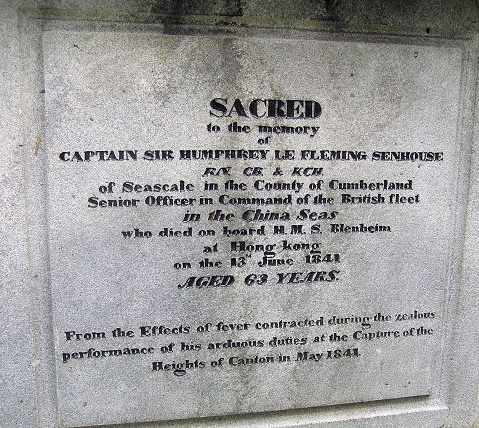
Captain Sir Humphrey Fleming Senhouse

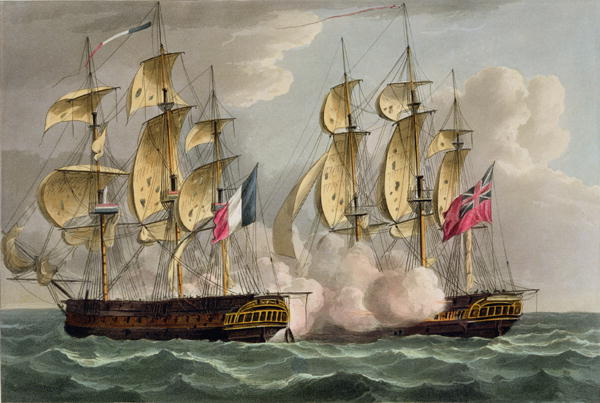
Humphrey Fleming Senhouse was born in 1781 in Barbados where his father, an officer in the Royal Navy, was serving as Surveyor General for Barbados and the Leeward Islands. Senhouse joined the Royal Navy in 1797 at the age of sixteen. His first ship was HMS Prince of Wales, which had been launched in 1794 at Portsmouth. She was a 98-gun ship-of-the-line. She was the flagship of Admiral Sir Henry Harvey, commander of the Leeward Islands Station, and responsible for the capture of Trinidad from the Spanish. Later that year, in November 1797 Senhouse transferred to the gun brig Requin, a former French warship (Le Requin) captured in 1795 and pressed into service with the Royal Navy. A small ship with a complement of around sixty officers and men and a single gun deck equipped with ten 4-pounders. The commander Lt William Wood Senhouse was one of Humphrey Senhouse's brothers. In 1799 Senhouse sailed to England on Requin. Senhouse then served on HMS Fishguard, a 48-gun frigate, formerly a French frigate (Resistance) that was captured by the Royal Navy in 1795.

The capture of French warship Immortalité by HMS Fisgard 
In 1802,  Senhouse passed the qualifying examinations and was promoted to Lieutenant. He served at the Battle of Trafalgar, 21st October 1805, onboard HMS Conqueror a 74-gun ship-of-the-line which was in the thick of the action throughout the battle. She was commanded by Captain Israel Pellew. Conqueror was in the van, she was fourth in line in the weather column led by the flagship HMS Victory. Villeneuve's flagship the Bucentaure surrendered to Conqueror's Captain of Marines who had been put aboard to take the surrender whilst Conqueror chased and engaged Santisma de Trinidad.

To find the link with Hong Kong, we have to fast forward through an illustrious naval career, in which Senhouse saw action in the War of 1812, commanded a number of warships, was knighted, and promoted to the rank of Captain. Mount Stenhouse (incorrectly spelt) on Lamma Island is named after him.

Mount Stenhouse on Lamma Island
Senhouse was posted to the China Station in April 1839 as second in command of the Naval squadron in China reporting to Commodore Sir James Bremer. He commanded HMS Blenheim, a 74-gun ship-of-the-line, in the First Anglo-Chinese War (1839-1841), more often referred to as the First Opium War. 

HMS Blenheim
Senhouse was involved in the action at the Bogue Forts and the fighting around Chuenpi Island in the Pearl River, the gateway to  Canton. At the Chuenpi Convention assembled in January 1841, the Chinese Commissioner Qi Shan agreed to cede Hong Kong Island to the British Crown. However, the Qing Court was not happy with this arrangement. They thought Qi had conceded too much and he was dismissed. The treaty was repudiated and hostilities were resumed. The British were not happy either and thought that Captain Charles Elliot the Superintendent of Trade had not extracted enough. Palmerston famously derided Hong Kong as being a barren rock, with hardly a house upon it, and which would never be a mart for trade. Elliot was recalled and replaced by Sir Henry Pottinger who was appointed as Plenipotentiary and Superintendent of Trade. The war was brought to an end in 1842 with the Treaty of Nanking in which amongst other concessions, including the establishment of treaty ports and reparations, Hong Kong was granted in perpetuity to the Crown.

Senhouse may have been present with Commodore Bremer at the de facto taking of possession of Hong Kong Island in January 1841. Later that year, he succumbed to fever and died on board HMS Blenheim on 13th June 1841. In accordance with his wishes, and bearing in mind that Hong Kong still had a doubtful future as a Crown Colony,  he was interred at the Protestant Cemetery in Macau. The iron-clad paddle steamer Nemesis arrived in Macau with his body on 16th June 1841.  His memorial can still be seen today in the old cemetery. 

Memorial for Senhouse in the Protestant Cemetery in Macau


Captain Sir Humphrey Fleming Senhouse (1781-1841)
He died aged sixty and was survived by his wife Elizabeth Manley. They married in 1810 and had nine children of which five predeceased him. Elizabeth lived on until 1865 when she passed away aged eighty-one. 

Sea Echo and The Pipeline under the Ocean (PLUTO) Project

In the early 1960s my parents bought a holiday bungalow at Greatstone-on-Sea in Romney Marsh, South East Kent. I still vaguely remember the family gathering around our kitchen table to think of a name and we chose Sea Echo.  Here's a rather dated photograph, taken with a Kodak Instamatic, of my sister Julie and I standing outside Sea Echo in 1969 or 1970. 

Sea Echo in 1969/1970 (Writers Collection)
My family sold the house long ago but it's still there, little changed and still bearing the name Sea Echo. Here's a photo I took earlier this year as I drove past.


Sea Echo in 2014 (Writer's Collection)
The house was unusual because it had walls that were two or three foot thick, but that's because it had a war history, but more about that later.  The house was in Leonard Road, at that time a small cul-de-sac with five similarly designed flat roofed holiday bungalows surrounded by shingle. Over the years Leonard Road grew longer, and with the development of the nuclear power station at Dungeness, a number of bungalows were built alongside the five original houses in Leonard Road, and likewise all along the coast with whimsical names like Linger Longer and Crackers.


Leonard Road was parallel to the coast road which ran from Littlestone-on-Sea to the rather bleak but fascinating foreland of Dungeness. Close to the road was a miniature railway which ran from Hythe to Dungeness operating steam engines. It still runs carrying day trippers up and down the coast.

The nearest town was New Romney which was linked to Littlestone-on-Sea by a broad tree lined road called the Avenue. New Romney had once been a flourishing port - one of the famous cinque ports. The sea has long since retreated but as recently as Victorian times old maps show a shallow bay open to the sea. Probably salt marshes at low tide with Littlestone-on Sea at the northern end of the mouth and Greatstone-on-Sea on the southern side. This can be seen in the 1816 map below:


Map showing Greatstone-on-Sea in 1816 (www.greatstone.net)
The area marked "The Warren" is now a seaside golf course. The open bite no longer exists and Great Stone and Little Stone are linked. The history of Romney Marsh has been a constant struggle with the sea. In Roman times ships sailed over a large and shallow bay to the Roman port of Portus Lemanis. In Saxon times it must have been largely a  salt marsh with navigable channels, some of which (salt marshes) remains today around Rye Harbour. The Saxons created innings to reclaim land and to harvest salt for commercial use. Sea walls were built  to keep out the sea and ditches and dykes to drain the marsh.

But let's return to Leonard Road and Sea Echo. There was a flight of wooden stairs that led to the wind-swept flat roof where water collected in pools. To the front across the small rail track and the coast road was the shingle beach. At high tide the sea came right up to the shingle bank and at low tide a vast expanse of sand and mud was exposed.  Here fishermen dug for lug worm for use as bait and we would sometimes cross the sands, sinking in patches of soft mud up to our ankles,  to go shrimping at low tide. This involved pushing a wide net along the sea bottom in three foot of shallow water. We would gather plenty of shrimps. It was hard work peeling them and then boiling them but they were sweet and tasty to eat and fresh from the sea.

Looking out to sea you could see across St Mary's Bay to the white chalk cliffs of Folkestone and Dover. Stand up on the highest sand dune at Greatstone near the Jolly Fisherman Hotel and on a clear day you can see bits of France. In the sea just off Littlestone is the wreck of a section of the Mulberry Harbour which was to be used in the invasion of Normandy,  but broke free whilst being towed  to wash up on this stretch of beach.

To the rear of Sea Echo there were miles of shingle and occasional gravel pits.  It's hard work walking on the shingle and in days gone by locals at Dungeness used to wear contraptions like snow shoes with a piece of board under their shoes to facilitate crossing the shingle.

Back then and even today there is a kind of enchantment  brought about by a sense of desolation, the wind ripping across the shingle, the gulls screeching, and that wide expanse of sea and sky. The constant battle with nature. On foggy nights you could hear the mournful blast of the fog horn from the lighthouse at Dungeness.  The long, low line of hills that run from the ragstone cliffs at Fairlight to the hump backed downs at Hythe mark the old Saxon shoreline.  There is so much history in this little corner of England that you are easily caught up under its spell.

The walls of Sea Echo were unusually thick and we knew that it had some connection with the PLUTO Project in World War 2 through which petroleum was supplied to the Allied invasion armies by cable-like pipes that ran under the channel, one of which emanated from Greatstone-on-Sea and another from the Isle of Wight.

I was in Chatham recently visiting the Regimental Museum of the Corp of Royal Engineers. There was a display on the PLUTO Project and there was a photograph (below) of what I thought was Sea Echo in World War 2 at which time it had been built as a pumping-house disguised to look like a seaside bungalow, and therefore escape the notice of German aircraft or German espionage. I am informed by a reader that the photograph is not of Sea Echo, but one off three similar bungalows known as  Boodle's Den at 49, Leonard Road.
.
Boodle's Den  (Photo from display at Royal Engineers Museum at Chatham)
Here's another war time picture showing the three houses on the western side of Leonard Road with the third one being Sea Echo and showing Leonard Road coming to an abrupt end at the shingle edge in the foreground. The nearest bungalow being Boodle's Den.

The three pump houses disguised as holiday bungalows (www. combinedops.com)

Thphotograph below shows Boodle's Den (No 49 Leonard Road) as it today looking quite different with an upper storey added.


In the wartime photograph below you can see the pipeline on huge drums being towed across the channel  to supply the fuel hungry armies with that vital life blood to prosecute the war and liberate occupied Europe from tyranny.


Laying the pipe-line (Source: www.combinedops.com)

 One of the huge drums  on the beach ……….ready to roll

Known as a conundrum (Source: www.greatsone.net)

 These two houses on the eastern side of Leonard Road were used  as accommodation

 Disguised as holiday bungalows (Source: www.greatstone.net)
The pipeline project PLUTO was hugely important to the war effort and allowed over a million gallons of petroleum per day to be carried across the channel. The fuel was transported by pipe line from Walton-on-Thames in Surrey to Greatstone-on-Sea where it terminated at the five PLUTO bungalows - one of which was Sea Echo and from where the pipeline carried on under the Channel to the French Coast.  The huge drums that were towed across the Channel and known as "Conundrums" each carried 30 miles of cable pipe.

Sea Echo with its three foot walls, the shingle, and the Saxon shoreline in the distance gave me an enduring affection for Romney Marsh and history generally.
   

As I went down to Dymchurch Wall,
I heard the South sing o'er the land
I saw the yellow sunlight fall
On knolls where Norman churches stand.

And ringing shrilly, taut and lithe, 
Within the wind a core of sound,
The wire from Romney town to Hythe
Along its airy journey wound. 


As I came up from Dymchurch Wall,
I saw above the Downs' low crest 
The crimson brands of sunset fall, 
Flicker and fade from out the West.

 Night sank: like flakes of silver fire
 The stars in one great shower came down;
 Shrill blew the wind; and shrill the wire
 Rang out from Hythe to Romney town.
 
                                                                                                    (John Davidson) 
……………..

The Duchess of Richmond's Ball on the Eve of Waterloo

These stanzas are taken from a much longer poem by Lord George Byron entitled Childe Harold's Pilgrimage. This a book length poem - so not for the faint hearted. I have shortened the several stanzas concerning the Eve of Waterloo to just two,  because it is these two which are most captivating, at least  for me. The first stanza vividly conjures up that ball hosted on 15 June 1815 in Brussels by the charming socialite,  the Duchess of Richmond. All the officers of any importance including the Duke of Wellington had been invited. It must have been a glittering occasion - the ballroom lit by a mass of candles - the officers in their dress uniform and the ladies in all their finery. 

There was a sound of revelry by night,
And Belgium's capital had gathered then
Her beauty and her chivalry, and bright
The lamps shone o'er fair women and brave men.
A thousand hearts beat happily; and when
Music arose with its voluptuous swell,
Soft eyes looked love to eyes which spake again,
And all went merry as a marriage bell;
But hush! hark! a deep sound strikes like a rising knell!
  
Did ye not hear it? — No; 'twas but the wind,
Or the car rattling o'er the stony street;
On with the dance! let joy be unconfined;
No sleep till morn, when youth and pleasure meet
To chase the glowing hours with flying feet.
But hark! — that heavy sound breaks in once more,
As if the clouds its echo would repeat;
And nearer, clearer, deadlier than before;
Arm! arm! it is — it is — the cannon's opening roar!


The Battle of Quatre Bras (painted by Lady Butler)

In the 1970 classic film "Waterloo" in which Christopher Plummer plays the Iron Duke it depicts the Duchess of Richmond's ball brilliantly with the military bands, the Scottish dancing, and the ceremony of the occasion . Here are some stills from that film.


Christopher Plummer as the Duke of Wellington in the 1970 film - 'Waterloo' 

The Duchess of Richmond's  Ball  (from the 1970 film 'Waterloo')
Some poetic license has been employed as in actual fact the ball was hosted on the eve of the Battle of Quatre Bras fought on 16 June 1815 two days before the Battle of Waterloo.

The Duchess of Richmond's Ball by Robert Hillingford (1870s)


It was whilst the Duke of Wellington was attending the ball that a messenger arrived from Marshal Blucher with news that Napoleon's army had crossed the border and were advancing towards Brussels. Officers hurriedly left and the next day the army was leaving Brussels heading south to bolster British  and Prussian positions at and around Quatre Bras which were facing the advancing French army.

But let us return to the poem where Byron sets the scene so well that we could almost be there :


 There was a sound of revelry by night,
And Belgium's capital had gathered then
Her beauty and her chivalry, and bright
The lamps shone o'er fair women and brave men.
A thousand hearts beat happily;

What a fabulous line that follows (below) depicting the romance of the occasion and what a vivid description of the music :

and when
Music arose with its voluptuous swell,
Soft eyes looked love to eyes which spake again


Then we are interrupted by the sound of the gun, the foe is approaching and the officers must make their leave to do battle on the morrow.

But hush! hark! a deep sound strikes like a rising knell!

Arm! arm! it is — it is — the cannon's opening roar!

Poetic license again as the cannonading had not yet commenced nor would it until the following day when the Prussian Army under Blucher which were on the left flank, were attacked and after a short and brutal battle suffered a defeat and had to withdraw and regroup. 

The British led Anglo-Dutch  army at Quatre Bras (literally 'four roads' or 'Cross Roads') on the right flank were attacked by Marshal Ney  who had some 42,000 men outnumbering the British who initially were defending the cross roads with only 6,000 men. Marshal Ney did not press home the attack fast enough and British reinforcements from  the direction of Brussels allowed Wellington to hold the position.

The following day Wellington withdrew his army to Waterloo where he intended to make a stand and …………….the rest as they say is history ! 


Friday, 21 February 2020

Robert Grindley Southerton - Stanley Internment Camp

This is the poignant story of a family who lived in Shanghai before the war. A husband, wife, and two children who became separated from each other by the outbreak of war. The husband, Robert Grindley Southerton, was interned in Hong Kong, the wife and son were incarcerated in Manila, and the eldest daughter was alone at the family home in Shanghai. For several months none of them knew where the others were, or even whether they were still alive. Reading their private letters I can see that they were a very loving and close family. At the time Robert Southerton was fifty-years-old, he had been a teacher most of his adult life. After graduating from Chester College, he came out to Hong Kong in 1912 at the age of twenty-one. He taught at the Diocesan Boys School (DBS) in Kowloon. He married Edith Ethel (known as Edie) nee Witchell in 1917. In the wedding photo below, he is in uniform and so I assume during WW1 he joined the HKVDC (the Volunteers).

Robert Southerton (Sr) and Edie at their wedding in 1917  (Lorna Loveland)
The wedding took place on 6 November at St John's Cathedral in Hong Kong. The Hong Kong Telegraph for 6 November reports on the well-attended wedding. The bride's father, Samuel Job Witchell, (known as Job), was the Manager of the well-known King Edward Hotel. Job Witchell had first come to Hong Kong in 1882 and had served with the Hong Kong Police Force. In 1897 he was an Inspector and at that time institutional corruption was widespread in the police force. An investigation was carried out and Job Witchell was sentenced to 6-month's imprisonment. I suspect he may have been something of a 'fall guy' as there were many others who got away lightly, or entirely, because of insufficient evidence. After release, Job became Manager of the brick and tile works at Deep Water Bay  (Brick Hill). In 1915 he took up his role at the King Edward Hotel, considered to be one of the best hotels in Hong Kong. Job died in 1925, in Hong Kong, at the age of sixty-seven, after having suffered from cancer. Despite the earlier stain on his character, he was always well regarded and his funeral was very well-attended. In 1929, the King Edward Hotel was destroyed by a fire. Nine of the hotel guests lost their lives, two were killed by the fire and seven by jumping from the upper floors. Two of the hotel's employees were killed.

Job Witchell  (Source: Lorna Loveland)

Robert gave up teaching at DBS and briefly worked for British American Tobacco (BAT). The couple's first child, a daughter Muriel (known as Mully), was born in Hong Kong in 1919. In 1922, a second daughter Lilian May died in infancy aged three months. Robert went back to teaching, firstly in Tsingtao, and then in Shanghai. A son, also named Robert Grindley Southerton, was born in Shanghai in 1926. Robert Southerton (Snr) taught  English, Maths and Sports and co-authored a book on maths. By 1941 he was the headmaster of the Shanghai Municipal Council (SMC) Polytechnic School (shown in the photograph below).

SMC Polytechnic Public School 
In July 1941, he and his his wife Edie, and their fifteen-year-old son Robert (known as Bob)  took a long vacation in Australia. They returned from Australia on the MV Neptuna which arrived at Hong Kong in November 1941. The family sailed from Hong Kong on the SS Yu Sang expecting to be back in Shanghai and to be reunited with their twenty-two-year-old daughter Muriel (Mully) by early December. Muriel worked as a stenographer for Confederation Life, a Canadian insurance company.

In a letter to his family written in August 1945, Southerton wrote that they arrived on the Yu Sang at Woosung, Shanghai and anchored offshore. It was December 1941, it was the eve of battle and tensions were running high. The next morning, before they could disembark, the ship was ordered to return to Hong Kong without docking in Shanghai. The ship anchored in Hong Kong harbour, but Edie and Bob, and another female passenger, Mrs McCready, were not allowed to leave the ship and go ashore. Armed police were put aboard to ensure they did not disembark. I can only assume that the reason for such harsh treatment was that Hong Kong had been subject to a compulsory evacuation order in July 1940. A large number of women and children had been allowed to stay because the women were in essential services, like nursing or working as stenographers for the government. However many had avoided the evacuation by being absent during registration, or simply failing to show up, and some had falsely claimed they were in roles for which there was an exemption, for example, being a business proprietor. Some had illegally returned after evacuation.   There was no restriction on men leaving the ship. Robert Southerton (Snr) went ashore and stayed with his wife's family members (the Witchell family) in Hong Kong. Robert planned to get ashore and then get help from the authorities for his wife and son to be allowed off the ship. Robert and his brother-in-law, George Witchell, sought help from Duncan Sloss, the Vice-Chancellor of HK University, he appealed to the Governor, Sir Mark Young on Southerton's behalf. George's niece, May Witchell, worked for Duncan Sloss at HKU. The intervention was successful, and it was arranged that the police would bring certain papers to the ship on Sunday 7 December. Once the papers were signed, Edie and Bob would be allowed to disembark. On that Saturday night (6 December) Robert came aboard with George Witchell, his wife, Dolly, and their daughter Norah. They had dinner with Edie and Bob and then left the ship at around 11:30 p.m. thinking everything would be sorted the next day.

At about midnight Edie heard a commotion in the saloon. It transpired that the ship had received emergency orders to sail to Singapore early the following morning. Edie was still not allowed off the ship to contact her husband. It was only when she threatened to jump off the ship that the police became a bit more accommodating. They allowed Bob, accompanied by a  policeman,  to go ashore and to inform his father who was staying at George Witchell's house. However, nothing could be done in time, and so it was decided that there was no point in Robert staying on the Yu Sang and going to Singapore. He, therefore, disembarked with the intention of getting a passage to Shanghai as soon as possible. That morning, Sunday 7 December, the day before the war began, the Yu Sang, along with many other ships that had been anchored in Hong Kong Harbour sailed under orders for Singapore. 

The Yu Sang stopped at Manila in the Philippines and anchored in Manila Bay on 9 December, the day after the war began. The Philippines, Malaya, Singapore and Hong Kong were all under attack. The Yu Sang was bombed by Japanese aircraft, and a ship anchored close-by was hit and set ablaze. After the air raid, the crew mutinied and insisted that the Captain take the ship to a safer location.  The ship moved away from Manila and anchored off Mariveles. She remained there for eleven days before returning to Manila to replenish food supplies. The passengers were taken off and moved by the Red Cross to Caloocan Golf Club in Manila. Edie and Bob were subsequently interned at Santo Tomas University. The campus became the largest civilian Internment Camp in Manila. The internees were mostly American (3,200) but there were a large number (900) of British and Commonwealth (mainly Canadian and Australian) internees. 

Santo Tomas University Internment Camp. (Source: Wikipedia)
Back in Hong Kong, after the Japanese captured Kowloon, Robert Southerton (Snr) was initially held at the Kowloon YMCA together other European civilians and the staff from the Kowloon Hospital.   He was later moved to the Kowloon Hotel Temporary Internment Centre. In late January, he was moved to Stanley Internment Camp. Those, like Robert, who lived in Shanghai were later repatriated back to Japanese controlled Shanghai. There were two repatriations, one in July and one in  December 1942. Robert returned to Shanghai in July 1942. On his ship, there were around twenty other internees. However, they were accommodated in cabins albeit sharing with five others. Robert Southerton (Snr) was reunited with his daughter Muriel in late September.

It was at about that time that he discovered his wife and son had not reached Singapore and instead had been interned in the Philippines. Edie and Bob were repatriated from Manila to Shanghai in September 1942. They were put aboard the Maya Maru, a former cargo ship which had been put to use as a trooper. Edie and Bob, together with about thirty other internees, were accommodated on platforms in the hold. The hold was also carrying army horses. The internees were allowed out on the deck during the day but at night they were confined to the hold which was infested with rats, cockroaches and other vermin. Edie had the unpleasant experience of being bitten by a rat. The ship took ten days to reach Shanghai and during that time some of the horses died from the heat and were left to rot in the hold.

The family were at last reunited. At first, British, American and Dutch civilians living in Shanghai were not interned. However, in February 1943, the Japanese decided to intern civilians from these countries. There were several different internment camps in and around Shanghai. The family were interned at Yu Yuen Road Camp from February 1943 until April 1945. In April 1945 they were moved to Yangtzepoo Camp until liberation in August/September 1945. Yu Yuen Road Camp held a large number of Shanghai Municipal Council employees. At Yangtzepoo Camp, Robert Southerton (Snr) was elected as Deputy Head of the internment camp. The family were repatriated to the UK after the war. Robert (Snr) weighed 190 pounds when he left Australia on the Neptuna in 1941, but by release in August 1945, he weighed only 138 pounds. The privations of life in Japanese internment camps, the diseases, the shortage of medicines and the lack of adequate food took its toll on their health. Robert Southerton died in February 1948 aged only fifty-six after suffering a heart attack. Edith died the following year in November 1949, having suffered a stroke,  she was only fifty-three.


Addendum:
The MV Neptuna on which the Robert, Edie and Bob took passage from Australia to Hong Kong was sunk during the Japanese air raid on Darwin in February 1942. She was unloading armaments when she was hit by bombs in the engine room and in the main saloon. Some of the ordnance ignited causing a massive explosion. Forty-five men were killed. The Maya Maru was sunk by an American submarine in July 1944. The Yu Sang was requisitioned by the US Navy, but was bombed and exploded in Manila Bay. Shanghai, once known as 'the Paris of the East', did not regain its former opulence in the immediate post-war period. After the Japanese capitulation, civil war returned to  China eventually leading to the defeat of the KMT by the communist forces.

After first writing this blog, with very little information other than a letter written by RGS (Snr) held at the Imperial War Museum, I was contacted by Lorna Loveland, the daughter of Robert (Bob) Grindley Southerton (Jnr). She had come across my blog whilst researching on the internet and I am indebted to her for the photographs and updated information on the family. Edie's niece, May Witchell, was in Stanley Camp with her married sister Maude and her Aunt (Dolly), her Uncle (George) and her cousin (Norah). May Witchell later married Colonel Lindsay Ride who set up the British Army Aid Group (BAAG) in Free China after having escaped from Sham Shui Po prisoner of war camp.

Photo Gallery:

RGS (Snr) (Source Lorna Loveland)

Edie (Source: Lorna)

Robert Grindley Southerton (Jnr) (Source: Lorna)

Muriel (Mully) Southerton (Source: Lorna)
The sinking of the MV Neptuna (Source: Wikipedia)

King Edward Hotel (1904-1929) (Source: Wikipedia) 


Acknowledgements 
Lorna Loveland for photographs and private letters
Ancestry.com
Log Book of Internees Stanley Camp (Imperial War Museum)
Frank Fisher's diary (Imperial War Museum)
Captives of Empire by Greg Leck
Letter from R. G. Southerton (Snr) dated 26 Aug 1945 (IWM Docs. 13452)
WWW.hongkongsfirst.blogspot.hk (for information about Job Mitchell's trial and the hotel fire)


.........................             


Saturday, 8 February 2020

965 Defence Battery, Royal Artillery in the Battle for Hong Kong

965 Defence Battery (965 DB) was an independent mobile battery primarily equipped with 18-pdr field guns and 2-pdr anti-tank guns. Its main role was beach defence in tandem with the beach defence pillboxes. The battery also had responsibility for the three guns located at Belchers Fort. The commanding officer was Major Basil Forrester. There were a total of four officers and 144 men including British and Indian Other Ranks (BORs and IORs). Lt Challoner appears to have been assigned from HKSRA to 965 DB.

British 18-pdr in France in 1940 (Wikipedia)
The 18-pdr field gun was the standard British artillery piece in WW1. It was known as the 'infantry killer'. The Germans used howitzers, which, with their higher trajectory could be fired from cover ie on the reverse of a hill. The howitzers were known as 'gun and bunker busters' and were more effective in trench warfare. The 18-pdr guns were mostly equipped with anti-personnel (AP) shells. The fuse  could be set to a maximum delay of 22 seconds allowing it to explode in the air with its mass of musket type balls being dispersed over a wide area cutting down infantry formations. The 18-pdrs were used in this capacity in the Battle for Hong Kong. In areas where the Japanse infantry were advancing (for example the ridge between Bridge Hill-Notting Hill and Sugar Loaf-the Twins one can still pick up many of these shot balls fired by 18-pdrs from 965 DB at Stanley. 

Balls from 18-pdr AP shells fired by 965 Defence Battery 

The infantry was supported by the Hong Kong Singapore Royal Artillery (HKSRA). They were equipped with 3.7-inch, 4.5-inch and 6-inch howitzers. They were referred to as the mobile artillery but, in fact, their guns were mostly located in pre-prepared battery positions and not moved around.  On the 19 December 1941, East Group Royal Artillery lost most of its howitzers in the eastern sector because of the lack of mule transport for the 3.7-inch howitzers and lack of towing trucks for the larger guns. On 19 December, following the Japanese landings on the night of 18 December, only one gun, a 3.7-inch from Tai Tam Fork Battery, was successfully brought back to Stanley.  
   L/Bdr Albert Shepherd, was a member of 965 DB. In his interview (IWM sound tape) he talks about the battle very briefly. He mentions being sent to Shau Kei Wan (must have been Tai Koo) and then withdrawing after coming under British artillery fire which suggests it was just after the initial  Japanese landings.
We got an order to go up to Shau Kei Wan Dock Yard.  We were in a truck pulling the 2-pounder gun. We then came under shell fire from British guns. We left the 2-pounder which was useless anyway. 
Shepherd was dismissive of the 2-pdr describing it as a 'pea-shooter'. In fact, it was quite a good weapon to combat light armoured vehicles and it was more effective than the Boys anti-tank rifle which was used by the infantry in Hong Kong, but was later replaced in other theatres by the PIAT. The 2-pdr AT gun fired a 40mm (1.6-inch) shell with an effective range of up to 1,000 yards. It had a crew of 3 to 5 men and could be towed by a 15-cwt light truck. It was used very effectively in the battle for Stanley knocking out two Japanse light tanks attacking the village from the Beach Road. 

2-pdr anti tank gun (Wikipedia)
15-cwt truck (D-Day Overlord.com)

The 18-pdr and 2-pdr guns used by 965 DB were fully mobile with dedicated towing trucks. They were frequently moved. The initial deployment was as follows (source: The Guns and Gunners of Hong Kong (Dennis Rollo):

INITIAL DEPLOYMENT

Location                              Guns                              Fate

Belcher's Upper                   1x6-inch                        put out od action (25/12)
Belcher's Lower.                  2x4.7-inch                     put out of action (25/12)
Repulse Bay                         2x18-pdr                      One retained at Belchers
                                                                                  One to Stanley
Tai Tam Bay                         2x18-pdr                       To Stanley  
Stanley Bay                          2x18-pdr.                      To Braemar Beach 
Promontory                          1x2-pdr                          Lost at Stanley (24/12)
Island Bay (Skek-O)            1x2-pdr                          Lost at Stanley (24/12) 
Deep Water Bay                   1x2-pdr                         Lost at Stanley (24/12)
Tai Ho Wan (Telegraph Bay) 1x2-pdr                         Lost at Tai Koo Docks (18/12)


This suggests an initial six 18-pdrs and four 2-pdrs


MOVEMENT FROM INITIAL DEPLOYMENT


Repulse Bay      One 18-pdr remained at Belchers, then moved to Wan Chai and destroyed.
                          One 18-pdr moved to Stanley and put out of action at Stanley View on 23/12

Tai Tam Bay          Two 18-pdr to Stanley on 19/12 and put out of action 24/25

Stanley Bay            Two 18-pdr to Braemar on 11/12 and destroyed there on 18/12 

Promontory            One 2-pdr to Stanley on 19/12 and destroyed 25/12

Island Bay              One 2-pdr to Stanley on 19/12 and destroyed 25/12

Deep Water Bay    One 2-pdr  to north shore (13/12)  then to Stanley (19/12). Lost 24/25.

Tai Ho Wan            One 2-pdr to Tai Koo docks area on 14/12 destroyed there on 18/19


The 965 Defence Battery war diary starts from 19 December and is very brief. However, from this and from the Royal Artillery war diary we can glean the following interim and other movements.

Movements:

7 December: 965 DB occupied its Beach Defence positions

13 December: Belchers Battery was ordered to fire on lighters at Kowloon wharves. This was undertaken by the 6-inch gun in the upper battery. Fire was seen to be effective with a number of vessels sunk. Battery received some counterbattery fire starting fires in the western district.

14 December: Belchers Battery came under very heavy shelling. The lower Battery Observation Post (BOP) was destroyed and the two 4.7-inch guns were put out of action. 2/Lt Field, the battery commander, was wounded and Master Gunner Cooper was fatally wounded and died the following day. One IOR was killed and two wounded. With the battery badly damaged the remaining IORS were redeployed to serve as infantry. 

14 December: Four Mk1 18-pdr saluting guns were drawn from Ordnance and sent to Stanley. It is unclear whether they were put into action, but I think unlikely. 

15 December: One 2-Pdr was positioned at PB 56 near the China Fleet Club. One 18-Pdr was located near Belchers Battery.

16 December: One 2-pdr moved to a position near Hong Kong Club and one to near Tai Koo Dockyard. The 18-pdr near Belchers remained in position.  Six 12-pdr naval guns were drawn from RN Dockyard and passed to 965 DB to be used at various locations on the south shore in order to free up the 18-pdrs and 2-pdrs to do more mobile work on the north shore. The 12-pdrs never got into action due to technical difficulties with mountings and other difficulties. 

18 December: two 18-pdr beach defence guns from 965 DB situated at Braemar Beach were destroyed by accurate Japanse artillery fire after movement of the guns had been spotted.

19 December: one 18-pdr, under 2/Lt Challoner, in position north of Prison Officers Club covering Tai Tam Road in the vicinity of Erinville (Turtle Cove/Red Hill area) and Shek-O Road. He fired some rounds at the Government Rice Store on Shek-O Road. The remaining two 18-pdrs were at Stanley Fort.
One 2-pdr located at Stanley Police Station. One 2-pdr  located on Fort Road (Wong Ma Kok Road) near playing fields covering Stanley Bay. These guns were supported by their own Beach Defence Searchlights (BDSL). 

20 December: Brigadier Wallis ordered an 18-pdr to be sited at Stanley View at which point it could fire at the Repulse Bay Hotel garage and the hillside of Middle Spur. This gun was commanded by 2/Lt Phillips and was very effective in taking out Japanese mortar positions on Middle Spur. 

21 December: One 2-pdr moved to Island Road near Southcliff to meet reported advance by Japanese light tanks from Tai Tam Gap.
All three 18-pdrs withdrawn to Stanley Fort and two 18-pdrs under 2/Lt Challoner moved to a position covering Tweed Bay. Later one 18-pdr moved to Southcliffe to replace the 2-pdr
Two 18-pdrs under Captain Roberts to Stanley Fort by day. 
Two 2-pdrs withdrawn back to Police Station in Stanley Village

22 December: One of 2/Lt Phillips 18-pdr guns was lost at Stanley View. The gun had come under mortar fire and some of the ammunition was hit. Although man-handled back to a safe position it was too badly damaged and had to be abandoned.  That left two 18-pdrs at Stanley and one at Belchers.

23 December: 2/Lt Challoner and one 18-pdr moved to a position north of Prison Officers Club to cover Island Road near Erinville.

24 December: The two 18-pdrs were located at Tweed Bay by night. One 18-pdr north of Prison Officers Club by day. One 2-pdr located 500 yards east of Stanley Village covering Tai Tam Bay. One 2-pdr at Stanley Police Station covering Stanley Village Road and Beach Road. One 2-pdr covering Stanley Bay from Fort Road at the north-west corner of playing fields. Total of three 2-pounders remaining.

25 December (north shore): At 1300 hours the 18-pdr at Belchers was deployed near Wan Chai Market to support 1/Mx. One of its tasks was to fire at ARP tunnels which could have given the Japanese access to Kennedy Road from Mount Parish.

25 December (south shore): All 2-pdrs overrun. The gun at Stanley Police Station claimed two Japanese light tanks disabled on Beach Road. Efforts made to withdraw one 18-pdr from Tweed Bay.  Later the two 18-pdrs were trapped near the pumping station (on Fort Road) by heavy Japanese MG fire. 

Some of the above movements taken from 965 Defence Battery war diary and the Royal Artillery war diary are a bit confusing. It is not clear whether the four additional 18-pounders (saluting guns) were put into action. If not I estimate that by Christmas afternoon there were just two 18-pdrs left and it proved impossible to get these back to Stanley Fort. The saluting guns may have been in the fort but I suspect not used. The remaining 2-pdrs had been overrun at the village during the night 24/25.  From 24 December the Japanese owned the overlooking hills and could direct counterbattery fire on the guns if spotted either by sight or flash and as a result, the guns were being moved frequently.


 British officers and partial list of BORs from 965 Defence Battery

SurnameFirst NameRankDate of Death
ForresterBasilMajorn/a
RobertsWilliam JohnCaptainn/a
ChallonerRichard Harold2/Ltn/a
PhillipsEric Gladstone2/Lt25-Oct-42
BoyceSamuel L/Bdr2-Oct-42
Burnley FredBdr2-Oct-42
CarleyJohnBSM2-Oct-42
ClimoReginald Thomas Sgt25-Dec-41
CookeLeonardGnr2-Oct-42
CooperClarenceBSM2-Oct-42
DownesLeslieSgt18-Dec-41
EllardCecilGnr2-Oct-42
HallWalterGnr2-Oct-42
HewittFrank EdwardGnr2-Oct-42
HewsonThomas JamesGnr2-Oct-42
HildredReginald JohnGnr2-Oct-42
InglisJohn L/Sgtn/a
KennyMichaelGnr2-Oct-42
LangridgeWalterGnr2-Oct-42
MaceFrank EdwardGnr2-Oct-42
McCarthyGeorge EbertGnr24-Dec-41
MinersJamesGnr2-Oct-42
NellistJamesGnr2-Oct-42
O'ConnellJeremiahGnr2-Oct-42
OrrTerence NolanGnr2-Oct-42
RobertsAlfred HenryBdr2-Oct-42
RodgersJosephBdr9-Jun-42
RoscoeRonaldGnr25-Dec-41
SalmonAndrewSgtn/a
ShepherdAlbertL/Bdrn/a
ShirleyErnest FrancisBSM1-Oct-42
SpillerFrederick JohnGnr3-Jun-43
StaffordArthur JohnL/Bdr7-Nov-42
SumnerWilliamBQMS1-Oct-42
ThomasDouglasGnr26-Jul-42
TownsendGeorgeGnr2-Oct-42
ViottoJosephGnr2-Oct-42
WardEric PhilipL/Bdr25-Dec-41
YeomanHerbert GeorgeGnr2-Oct-42
n/a  Not applicable
Main Source of list:  Tony Banham's Hongkongwardiary.com